

At 11:18 pm Eastern Time on July 4 (03:18 GMT 5 July) NASA’s Joint Propulsion Laboratory in California and Lockheed Martin’s mission operations control center in Denver, Colorado burst into cheers and applause as the Juno spacecraft signaled it had entered orbit around the “king of the solar system” – the giant planet Jupiter.
The spacecraft performed exactly as planned, executing a complex series of steps that included a gravity assist to pick up speed, orienting away from the sun and switching to battery power, spinning up rotation of the spacecraft itself in order to stabilize it prior to its “JOI” – Jupiter Orbital Insertion burn. During JOI, Juno fired its engines to slow down allowing Jupiter’s gravity to capture it. Then, Juno cut off the engines in order to achieve an elliptical orbit around the massive planet.
“NASA did it again!” said Scott Bolton, Primary Investigator for the mission, during NASA’s post-insertion burn press conference.
“Tonight, 540 million miles away, Juno performed a precisely choreographed dance at blazing speeds with the largest, most intense planet in our solar system,” said Guy Beutelschies, director of Interplanetary Missions at Lockheed Martin Space Systems. “Since launch, Juno has operated exceptionally well, and the flawless orbit insertion is a testament to everyone working on Juno and their focus on getting this amazing spacecraft to its destination. NASA now has a science laboratory orbiting Jupiter.”
The week before the mission, the Coalition’s Executive Director Dr. Mary Lynne Dittmar sat down with Beutelschies who oversees the mission for Lockheed Martin, NASA’s industry partner on the Juno program. Beutelschies explained that the focus of this mission is really Jupiter itself, rather than moons such as Europa or Io. Juno will explore how and where Jupiter formed, which may provide insight into how the rest of our solar system formed. Determining whether Jupiter has a solid core is key to these insights. Juno will investigate this question by measuring Jupiter’s gravity field using radio waves – and to do that, the spacecraft has to be very close to the planet, operating in an extreme radiation environment. Additional investigations will determine the ratio of water to other trace elements in Jupiter’s environment, which will in turn help us determine where it formed in the solar system.
The first orbit of the Juno spacecraft will take 53 ½ days, which will provide time for a complete check out and initial operations of the instruments onboard Juno, including “JunoCam”, which will provide detailed images of the planet. Members of the public will eventually be able to guide the camera through social media, bringing the public directly into the mission. Subsequent orbits will take 14 days and pass over as much of the planet’s surface as possible during its 16-month science mission.
Click here for a video from NASA that combines animation of Juno’s journey with real footage taken by Juno’s cameras of the orbit of Jupiter’s moons around the giant planet
You can follow Juno’s mission on Twitter: @NASAJuno, or download NASA’s new “NASA Eyes” application for PC or Mac, which allows you to follow progress on several NASA planetary missions, at https://eyes.nasa.gov.
Check out photos of the Lockheed Martin team celebrating Juno’s arrival at Jupiter here.
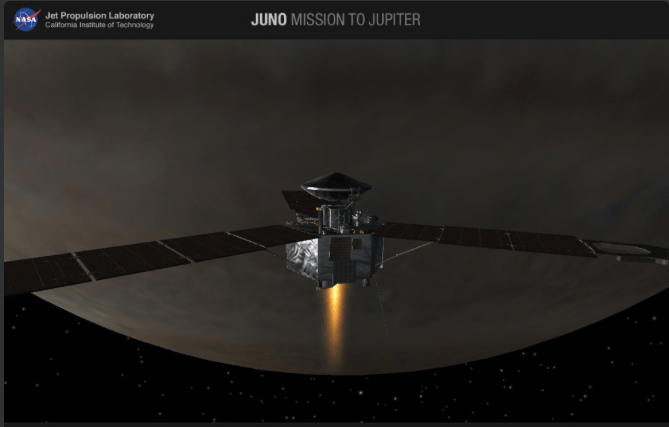
Artist’s conception (animation) of Juno’s burn to slow down and enter Jupiter orbit (JPL)