
In Today’s Deep Space Extra… Webb telescope almost ready. Mars shines in the night sky as NASA’s Perseverance rover nears landing.
Human Space Exploration
NASA boss: We have “every indication” that Artemis is safe under Biden
Futurism (2/2): Every indication from the Biden administration so far is that NASA’s Moon-to-Mars Artemis initiative will not be abandoned, according to agency Acting Administrator Steve Jurczyk in an interview. The Artemis program intends to return humans to the Moon to demonstrate technologies for expeditions to Mars and to conduct a myriad of science investigations. Budgets, however, could affect the timing of a human lunar return, which under the previous administration was planned for 2024. (Paywalled after 5 articles)
Space Science
The Webb telescope, NASA’s golden surfer, is almost ready, again
Coalition Member in the News – Northrop Grumman
New York Times (2/2): NASA’s James Webb Space Telescope (JWST) is in the final stages of coming together at Northrop Grumman facilities in Redondo Beach, California. Despite the workplace challenges of the coronavirus pandemic, the JWST is expected to launch from French Guiana on October 31 atop an Ariane 5 rocket provided by the European Space Agency (ESA). The space observatory will travel about one million miles from Earth to study the earliest stars and galaxies and look for biosignatures in the atmospheres of exoplanets.
MESSENGER saw a meteoroid strike Mercury
Universetoday.com (2/2): Back in 2013, NASA’s Messenger mission to Mercury may have imaged a first as it witnessed a meteoroid striking the surface of the solar system’s smallest and closest planet to the sun. The surprise discovery, found in archived imagery, was chronicled in the journal Nature Communications.
Opinion
Advice to Biden: Stay on pace in space
Coalition Member in the News – Paragon Space Development Corp.
Florida Today (1/29): In an op-ed, Grant Anderson, president and CEO of Paragon Space Development Corp., explains why space exploration represents an essential part of the nation’s future. With success, exploration offers economic, scientific, as well as national security dividends. But moving ahead effectively requires bipartisan support. “America must stay on pace in space and assuming we can, buckle up for some great years ahead,” writes Anderson.(Paywalled after 3 articles)
Other News
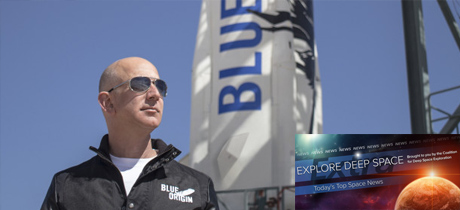
Jeff Bezos’ role at Blue Origin hints at how his profile at Amazon is likely to change
Geekwire.com (2/2): In a note to employees, Jeff Bezos said stepping down as CEO of Amazon will provide more time for his other passions, which include Blue Origin, his space enterprise and one of three commercial teams competing to develop a NASA contracted lunar Human Landing System (HLS).
SpaceX Starship crashes after suborbital flight
SpaceNews.com (2/2): For the second time in a row, SpaceX’s Starship crashed as it was landing during a suborbital test flight launch from the company’s facility in Boca Chica, Texas. After rising vertically to an altitude of 10 kilometers, the Starship SN9 vehicle maneuvered horizontally for its descent. As the rocket prototype attempted to orient vertically for the touchdown, it crashed to the ground. Tuesday’s test flight launched after the Federal Aviation Administration (FAA) lifted a flight restriction. After yesterday’s test the FAA also said it will investigate the root cause of this latest mishap.
Diversion
What’s Up: February 2021 skywatching tips from NASA
NASA Science (2/3): As NASA’s Mars 2020 Perseverance rover nears arrival at Mars on February 18, the Red Planet is also quite easy to view in the night sky after sunset. Look to the west for the object with a reddish tinge all month. On the night of the landing, Mars will be next to a half full Moon. Other night sky viewing opportunities this month include Mercury, Jupiter and Saturn.