
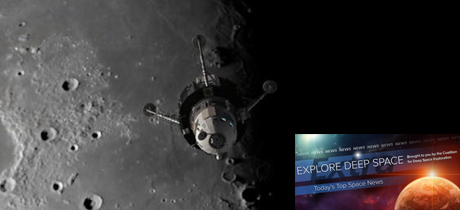
In Today’s Deep Space Extra… Scientists and engineers are helping NASA determine the precise location of the Artemis Base Camp concept. The Mars Reconnaissance Orbiter might support the Mars 2020 mission.
Human Space Exploration
NASA finalizing location for Artemis base camp
Futurism (1/28): Once NASA astronauts return to the Moon as part of the Artemis program, they will be looking to establish a base camp to develop a sustained human presence. The lunar south pole is a leading candidate location for the base camp that might be located on the rim of an impact crater with access to sunlight to generate electricity. The base camp site could have access to a permanently darkened crater floor, with a potential reservoir of water ice. The ice could serve as a source for life support and production of liquid oxygen rocket propellant.
Airbus studies “Moon cruiser” concept for ESA’s Cis-lunar Transfer Vehicle
Parabolicarc.com (1/28): The European Space Agency (ESA) has selected Airbus to study a Cis-Lunar Transfer Vehicle (CLTV) concept for a Moon Cruiser, an autonomous logistics vehicle that would play a role in ESA and NASA Artemis initiatives, including support for the NASA-led lunar Gateway. CLTV would be launched by an Ariane 6 rocket.
Glavkosmos to sell seats on Soyuz missions
SpaceNews.com (1/28): Glavkosmos, the commercial arm of the Russian space agency Roscosmos, announced Thursday plans to market four seats aboard its Soyuz spacecraft through 2023. The plan calls for two three-person Soyuz capsules to have one professional cosmonaut and two space tourists. The first mission could launch in the fall of 2022 to the International Space Station (ISS). Glavkosmos inherits a marketing function once performed by the U.S. company Space Adventures.
Space Science
NASA may change MRO orbit to support Mars 2020
SpaceNews.com (1/29): NASA is considering changing the orbit of its Mars Reconnaissance Orbiter (MRO) to support the Mars 2020 mission, but the change could disrupt the orbiter’s mission. The agency intends to make a decision following the landing and initial operations of Mars 2020, NASA officials said this week.
Mysterious ‘kick’ just after the Big Bang may have created dark matter
Space.com (1/28): The Big Bang produced equal amounts of matter and antimatter with opposite electrical charges, according to the prevailing theory that holds much of the matter and antimatter could have cancelled each other out. There’s an abundance of matter, which according to a new study may have resulted from a second jolt that created an imbalance of matter as well mysterious dark matter. A study suggesting that and more was published as 2020 came to a close in the preprint database arXiv, where it awaits peer review.
Opinion
Why Biden must pursue space diplomacy with Russia and China
POLITICO (1/29): The U.S. “exacerbated a national security threat and risked the economic opportunity it hoped to secure in outer space by failing to engage Russia or China as potential partners” in the Artemis Accords, according to Elya Taichman, a former legislative director in Congress. Taichman adds that the Accords have driven China and Russia toward cooperation in space out of fear.
Other news
Seventeen industry groups are urging the White House to keep the National Space Council
POLITICO Space (1/29): Industry groups including the Coalition for Deep Space Exploration, penned a letter to Ron Klain, President Biden’s chief of staff, and Hartina Flournoy, chief of staff to Vice President Kamala Harris, on Thursday, explaining why the panel has been crucial to facilitate partnerships between the civil, commercial, and national security space communities.