
In Today’s Deep Space Extra… BREAKING: Space Symposium postponed due to ongoing challenges with the coronavirus/COVID19. Experts ponder how astronauts far from Earth might deal with a coronavirus like health concern. NASA and the European Space Agency (ESA) select solar radiation and space weather instruments for the future lunar Gateway. The joint European/Russian ExoMars mission launch delayed primarily due to technical issues.
Space Symposium
Space Symposium suffers blow with coronavirus travel ban
The Gazette (3/12): The Space Symposium has suffered a blow with the travel restrictions ordered by the White House, writes Jerilee Bennett of the Colorado Springs Gazette.
EDITORS’S NOTE: Last evening the Space Foundation began contacting sponsors, and this morning, Thomas Dorame of the Space Foundation began sending letters out to Space Foundations “friends and partners” (CDSE is one) advising them of the decision to postpone. A formal press release is coming later this morning, according to the letter.
Human Space Exploration
Getting sick in space: How would NASA handle an astronaut disease outbreak?
Space.com (3/12): Over the history of human space flight, medical experts have been primarily concerned with astronaut illnesses such as respiratory infection, or colds, urinary track and skin infections. Viruses and bacteria and aspects of human physiology behave differently in space. While concerns on Earth are growing over exposure to the coronavirus and strategies for testing and isolating those who may be infected, it might be necessary for an astronaut dealing with a serious illness to be quarantined, even aboard a small spacecraft far from Earth.
Space Science
NASA selects first science instruments to send to Gateway
NASA (3/12): NASA has selected two science investigations for a place aboard the human tended, lunar orbiting Gateway. The pair will monitor solar radiation and observe space weather. They come from the European Space Agency (ESA) and NASA. The Gateway is a key part of NASA’s strategy to return to the surface of the Moon with human explorers in 2024.
Coronavirus and technical issues delay a Mars mission’s launch
New Scientist: (3/12): The coronavirus concern was among the latest issues to prompt a decision Thursday by leaders of the European and Russian space agencies to delay by two years the planned July/August launch of the Rosalind Franklin ExoMars lander and rover to Mars in search of evidence for past or current microbial life. Travel between European and Russia, now restricted, would hamper efforts to resolve parachute and electronics issues prior to the opening of the launch period. However, even prior to the coronavirus concerns, there were enough technical issues to prompt the delay, according to Jan Worner, director general of the European Space Agency (ESA).
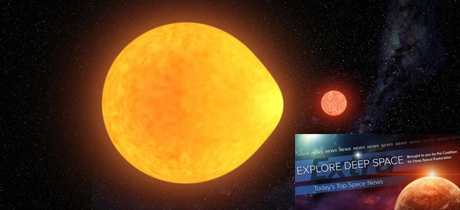
Weird new star type pulses on only one side
Space.com (3/12): NASA’s Transiting Exoplanet Survey Satellite (TESS) has provided data enabling amateur astronomers to help identify a star shaped like a tear drop, or one that is lopsided and induced to pulse strangely by a smaller companion star. The findings were published this week in the journal Nature Astronomy.
Physicist: Our galaxy may be located inside an enormous bubble
Futurism (3/12): A theory from University of Geneva physicist Lucas Lombriser proposes that the entire Milky Way galaxy resides in a vast bubble in which the matter we interact with is less dense than anywhere else. The hypothesis is based on competing estimates of the expansion rate of the universe. Neighboring galaxies may also share volume in the bubble, according to the proposition outlined in the journal Physics Letters B.
Other News
Aerojet Rocketdyne to open new facility to develop solid rocket motors
Coalition Members in the News – Aerojet Rocketdyne, Northrop Grumman, United Launch Alliance
SpaceNews.com (3/13): Aerojet Rocketdyne anticipates a Spring 2020 opening for its new solid rocket motor production facility in Camden, Arkansas. The company closed production at facilities in Sacramento, California, when United Launch Alliance (ULA) turned to Northrop Grumman for production of solid rocket boosters for the Atlas V and future Vulcan launch vehicles in 2015. This week, Aerojet announced the installation of a new steel casting bell in Camden.
Tory Bruno outlines ULA transition to Vulcan and national security launches
Coalition Members in the News – Boeing, United Launch Alliance
NASAspaceflight.com (3/12): In remarks before the Satellite 2020 conference in Washington, United Launch Alliance (ULA) CEO Tory Bruno discussed a timeline for introduction of the company’s new Vulcan launch vehicle for U.S. national security and other government missions, including NASA’s. The ULA’s Delta 4 and Atlas V will likely see their final launches in the 2023-24 time frame, possibly even 2022 for the Atlas V. The Vulcan first stage will be powered by the new Blue Origin BE-4. Like the Atlas V, Vulcan must be human rated for the launch of Boeing’s CST-100 Starliner for the transport of NASA astronauts to and from the International Space Station (ISS).
Will Space Command come to Florida? State leaders ready to make the case once again
WMFE Radio of Orlando Florida (3/13): U.S. Air Force Secretary Barbara Barrett informed a U.S. House oversight panel last week that the Pentagon has reopened an assessment of where to locate the headquarters for the Air Force’s Space Command, which will support the recently established U.S. Space Force, which is headquartered within the Pentagon. Florida’s Space Coast is expected to be a strong contender, according to state officials.
Assure Space won’t cover collision risk in low Earth orbit
SpaceNews.com (3/11): Assure Space is a space insurance underwriter. During his participation at this week’s Satellite 2020 conference in Washington, Richard Parker, the company’s managing director, said Assure Space has stopped offering collision risk coverage for low Earth satellites. Coverage continues for satellites in geostationary orbit, those rising through low Earth orbit and missions to the International Space Station (ISS).