
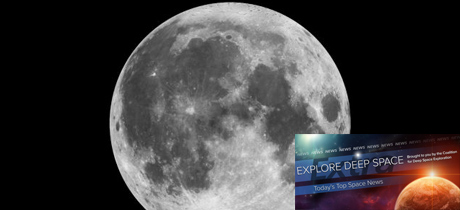
In Today’s Deep Space Extra… New studies suggest the Earth and Moon are not necessarily made of the same stuff. Holding on to NASA’s aging Mars Odyssey might be wise. NASA, the European Space Agency (ESA) and South Korea join to improve Earthly air quality monitoring from space.
Human Space Exploration
Astronauts capture SpaceX cargo capsule with robot arm for final time
Spaceflightnow.com (3/9): The arrival early Monday of SpaceX’s 20th NASA contracted resupply mission to the International Space Station (ISS) marked the final time the company intends to rely on the orbiting lab’s Canadian robot arm to grapple its Dragon cargo capsules prior to berthing. Under a second generation resupply agreement, SpaceX will turn to the cargo version of the Dragon 2, which is equipped with an automated docking system. On Monday, NASA astronauts Jessica Meir and Drew Morgan commanded the Station’s robot arm to grapple the capsule as it approached the Station with a 4,300 pound cargo of science experiments and supplies.
Space Science
Surprise! Earth and the Moon aren’t made of exactly the same stuff
Space.com (3/9): For much of the past three decades the prevailing theory of how the Earth’s moon formed was through a collision between the young Earth and a Mars-sized object called Theia. Computer modeling suggests that 70 to 90 percent of the Moon should then be comprised of material from Theia. Past studies of Apollo Moon rocks, however, seemed to reveal similarities to Earth in composition. A new study led by a University of New Mexico scientists, suggests the Earth and Theia were similar but with key differences.
Is the end near for Mars Odyssey? Trump’s proposed 2021 budget could doom long-lived mission
Space.com (3/9): NASA’s proposed budget for 2021 would effectively end the mission of the Mars Odyssey orbiter, which was launched to the Red Planet in early 2001. Soon after reaching Mars, Odyssey detected evidence of subsurface water. Currently, the long running mission provides a communications link between NASA’s Curiosity rover, which landed in Gale Crater in August 2012, and researchers on Earth. The proposal is puzzling to the Mars community because Odyssey appears healthy enough to operate for another decade. NASA’s Mars 2020 rover is due to launch in mid-2021 to seek evidence of past microbial life on Mars and to gather and cache samples of rock and soil for eventual return to Earth. The communications link could prove vital for that mission.
OSIRIS-REx did its closest flyover yet, just 250 meters above its sample site
Universe Today (3/9): Normally, NASA’s Osiris-Rex sample return mission orbits its target, the primitive, carbon rich asteroid Bennu at an altitude of 1 kilometer. A week ago, the probe left orbit to swoop just 250 meters above Nightingale, the name of a northern hemisphere impact crater selected earlier as the probe’s primary site to collect a sample of surface material in late August for return to Earth in September 2023. Launched in September 2016, Osiris-Rex reached Bennu in December 2018. Scientists hope that samples of the asteroid will help to explain how the Earth acquired water and organics, the building blocks of life, during the solar system’s planet forming epoch.
Scientists will soon be able to monitor air pollution hourly from space
Verge (3/10): NASA, the European Space Agency (ESA) and South Korea’s are collaborating to establish hourly space surveillance capabilities to monitor air quality across much of the most populated regions of the Earth through individually launched geosynchronous satellite sensors. They will improve current air quality surveillance provided by polar orbiting, sun synchronous satellites that fly over specific regions of interest once per day. Earthly air quality is a human health concern as well as an overall environmental factor.
Op Eds
Japan’s space program aims at the moons of Mars
Asia Times (3/10): “Japan has an advanced space program that belies its media portrayal, and is a highly successful team player,” explains Dr. Paul Kallender, a senior researcher in the Keio Research Institute at Shonan Fujisawa Campus, who has been researching and writing about Japan’s space program for the last 25 years. Japan’s achievements in the Hayabusa program and its plans for robotic exploration of the Martian system are positioning it for a round trip mission to the moons of Mars, writes Scott Foster, who provides a comparative assessment of the Japanese space program.
Other News
White House considering space policies on cybersecurity, supply chain, nuclear power
SpaceNews.com (3/9): Speaking Monday before the 2020 Satellite Symposium in Washington, former National Space Council (NSC) member Mir Sadat said the NSC is weighing a policy directive that would require the domestic aerospace industry to adopt cyber security standards to protect data and intellectual property from hackers attempting to steal U.S. space technologies. “If we’re going to start relying on smallsats, we have to make sure that these things don’t get hacked,” he said.
SpaceX raising over $500 million, double what Elon Musk’s company planned to bring in
CNBC.com (3/9): SpaceX is raising half a billion dollars in new funding, according to documents seen by CNBC on Monday, as the Elon Musk company continues work on three ambitious projects. The company authorized $500.06 million at a price of $220 per share, the documents show, and values SpaceX at around $36 billion, up from $33.3 billion last year. Notably, the round is about double the $250 million that SpaceX was looking to raise, as CNBC reported previously.
Successful launch takes China a step closer to completing Beidou navigation constellation
SpaceNews.com (3/9): A Long March-3 rocket variant launched Monday to successfully place a Chinese Beidou positioning, navigation and timing satellite in a geosynchronous transfer orbit. The satellite is the next to last in a planned 35 layered spacecraft global positioning system network for military and civilian users.
Review: The Vinyl Frontier
The Space Review (3/9): A new book, the Vinyl Frontier from journalist Johnathan Scott, recounts how famed astronomer Carl Sagan and a small group of colleagues managed to create the golden records that characterize the human culture of their era in a variety of areas and include them on NASA Voyager 1 and 2 spacecraft launched to the outer solar system in 1977. The recordings were meant as a message to a distant intelligent race that might happen upon one of the two spacecraft, which are still on their journeys and well beyond the distant bounds of the solar system.