
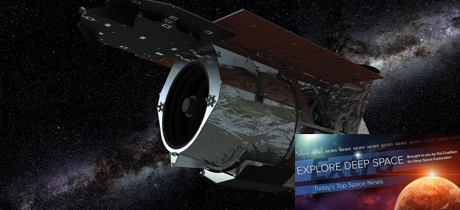
In Today’s Deep Space Extra…The next-generation Wide Field Infrared Space Telescope (WFIRST) is approved for development. DARPA selects Northrop Grumman as its commercial partner for satellite servicing. Researchers have identified a new research path that may help in the search for life on Mars. Employees of NASA and the U.S. Air Force have been requested to participate Friday in a work from home exercise in case the coronavirus outbreak prompts a response requiring an extended work from home requirement.
Space Science
WFIRST, proposed for cancellation, is approved for development
SpaceNews.com (3/4): NASA’s Wide Field Infrared Space Telescope (WFIRST) cleared a mission development milestone earlier this week as it was approved for hardware development and testing. The clearance came even though NASA budget proposals for 2019, 2020 as well as 2021 have sought to cancel development until the James Webb Space Telescope (JWST) can be launched to begin a 5 to 10 year mission. Congress has reversed 2019 and 2020 attempts at cancellation and work on WFIRST will continue at least through the end of the 2020 fiscal year, September 30. The development cost for WFIRST is capped at $3.2 billion through launch and $3.93 billion when including a developmentally challenging coronagraph and five years of operations. The launch of WFIRST, which is designed for studies of dark energy, mapping of dark matter across the universe and observations of extra solar planets, is currently planned by 2026.
A new way to test for life on Mars
Air and Space Magazine (3/4): A look at biotic and abiotic pathways that could explain the presence of a class of sulfur organics known as thiophenes detected on Mars by the NASA Curiosity rover, which touched down in Gale Crater on the Red Planet in August 2012. Much of the science community is focused on whether the thiophene compounds are indigenous to Mars rather than contamination from Earth.
Did dark energy cause the Big Bang?
Space.com (3/4): A new look at the big bang theory and efforts to reconcile it with dark energy, a force driving the expansion of the universe , suggests the mysterious force may have changed over time in puzzling ways.
When Voyager 2 calls home, Earth soon won’t be able to answer
New York Times (3/4): NASA’s Voyager 2 and its companion Voyager 1 were launched in 1977 to explore the furthest reaches of the solar system. Efforts to communicate with Voyager 2, now 13 billion miles from Earth, will be suspended for an estimated 11 months so that NASA can upgrade the Deep Space Network (DSN). The DSN is a collection of three ground stations positioned around the world and other assets needed to send commands and receive data from satellite beyond Earth orbit. As recently as January, a transmission from Earth was necessary to restore some Voyager 2 functions, an indication of the network’s critical importance. The DSN upgrades are needed to support missions awaiting launch to Mars this summer. Transmissions from Voyager 2 to Earth will continue to be received.
Op Eds
The government has a duty to fund space policy
Indiana Daily Student: Independent student newspaper of the University of Indiana (2/24): In an op-ed, junior Carter Cooley argues that all of NASA, from human exploration to science and educational initiatives, are essential to the future of the nation and thus to its citizens and humanity in general.
Other News
DARPA picks Northrop Grumman as its commercial partner for satellite servicing program
Coalition Member in the News – Northrop Grumman
SpaceNews.com (3/4): Northrop Grumman on Wednesday announced the Defense Advanced Research Projects Agency’s (DARPA) selection of the company as its commercial partner for the Robotic Servicing of Geosynchronous Satellites program. The selection comes in the aftermath of Northrop Grumman’s Mission Extension Vehicle (MEV-1) satellite servicing mission success. Launched last October, MEV-1 docked in Earth orbit to an aging Intelsat communications satellite on February 25 to demonstrate a strategy to keep the satellite operational for another five years. Northrop Grumman will provide DARPA with a satellite bus equipped with two robot arms, tools and sensors for geosynchronous satellite servicing.
Cygnus mission extended for tests of communications payload
Coalition Member in the News – Northrop Grumman
SpaceNews.com (3/4): Northrop Grumman’s 12th NASA contracted resupply mission to the International Space Station (ISS) departed the orbiting science lab January 31 after a four month stay for what was to be an independent extended mission lasting another month. However, the company’s Cygnus capsule remains in orbit for an additional period to carry out a cell phone communications demonstration for Lynk, a Virginia based company.
Changes coming to KSC and Cape Canaveral for Blue Origin’s New Glenn rocket
Florida Today (3/4): About 30 miles of roadway linking major facilities at NASA’s Kennedy Space Center and Cape Canaveral Air Force Station on Florida’s space coast are to undergo a multi-million dollar upgrade, including widening, lighting, fencing and signage to accommodate future over the road transportation of Blue Origin’s New Glenn rocket. Blue Origin hosts a rocket factory east of Kennedy’s main gate.
NASA, Air Force conduct telework test on Friday as coronavirus threat looms
Politico (3/4): Employees of NASA and the U.S. Air Force have been requested to participate Friday in a work from home exercise in case the coronavirus outbreak prompts a response requiring an extended work from home requirement. At NASA, however, preparations for the previously scheduled launch of a NASA contracted SpaceX resupply mission from Cape Canaveral Air Force Station, Florida, at 11:50 p.m., EST, will continue. Regarding the USAF, the test of capabilities will involve employees who already have an agreement for regular or situational telework, and will not be expanded to all employees, according to the report.