
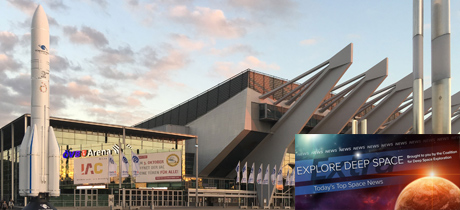
In Today’s Deep Space Extra… Enthusiasm for a return to the Moon with human explorers was abundant at this month’s International Astronautical Conference (IAC). Russia’s plans to soon complete an investigation into the October 11 abort of a Soyuz rocket bound for the International Space Station (ISS) with NASA astronaut Nick Hague and cosmonaut Alexey Ovchinin aboard should clarify the schedule for future Space Station activities. Both men returned to Earth safely.
Human Space Exploration
Over the Moon about the Moon
The Space Review (10/22): Evidence of enthusiasm for a human return to the Moon with robots seemed to be everywhere earlier this month at the annual International Astronautical Conference (IAC) gathering in Bremen, Germany. The latest Moon drive, initiated last December by the White House Space Policy Directive-1 is to marshal the efforts of partner nations and private companies, an enthusiasm for which was on display in Bremen. The challenge will be translating the enthusiasm into action and a momentum to deal with the inevitable delays, writes TSR editor Jeff Foust.
Roscosmos to complete Soyuz accident investigation this month
SpaceNews.com (10/22): Citing a report from RIA Novosti, it appears one of the four first stage boosters to the Soyuz-FG rocket that was forced to abort its launch to the International Space Station (ISS) on October 11 was not attached properly. NASA astronaut Nick Hague and cosmonaut Alexey Ovchinin descended safely to Earth in their crew transport capsule. Russian authorities have stated their investigation into the cause and strategy for preventing a recurrence are to be complete by October 30.
Russia’s space agency to specify date for ISS crew return and next launch after October 30
TASS of Russia (10/23): Once a Russian investigation into the cause of the October 11 launch abort of a Soyuz rocket bound for the International Space Station (ISS) with NASA astronaut Nick Hague and cosmonaut Alexey Ovchinin is complete at the end of this month, the Russian space agency will be prepared to announce dates for the return of the Space Station’s current U.S., European and Russian crew as well as the launch of more Space Station crew members. Plans for a Russian spacewalk to look for external damage that may have contributed to a small leak in the Station’s Russian segment that was detected and repaired in late August is also anticipated.
How many space stations does this planet need?
Coalition Members in the News – Axiom Space, Boeing, NanoRacks, Lockheed Martin, United Launch Alliance
New York Times (10/22): A visit to Bigelow Aerospace in Las Vegas, Nevada, may offer a hint at what a transition in human space exploration activities from low Earth orbit to deep space might look like. Founder Robert Bigelow’s vision embraces the launch of compact space stations and planetary surface habitats that can be folded up, then expanded upon reaching their designated destinations. Companies like his would provide the living space. Agencies like NASA would pay to occupy them.
NASA tests astronaut survival systems for Orion splashdowns
Space.com (10/22): NASA is preparing its astronaut corps for the final phases of future Space Launch System (SLS)/Orion missions to deep space destinations by testing survival systems in conjunction with the U.S. Air Force and the Goddard Space Flight Center.
Space Science
Hubble’s feeling better, JWST making progress
Spacepolicyonline.com (10/22): Experts believe they are close to overcoming the Hubble Space Telescope gyroscope ills in order to restore guidance to the 28-year-old observatory. Hubble slipped into “safe mode” earlier this month when one of three operational gyroscopes faltered and a backup erroneously displayed high spin rates. A series of tests appear to have cleared an internal difficulty. Normal operations could resume soon, Paul Hertz, NASA’s Astrophysics Division Director, told an advisory panel on Monday. Hertz’s NASA colleague Eric Smith also told the same panel the James Webb Space Telescope is making progress towards its recently revised launch date of March 2021.
Salty water on Mars could have enough oxygen to support life
USA Today (10/22): Recent studies suggest Mars hosts regions of subsurface water. If the water is briny, a factor that would lower its freezing point, it may also be oxygen rich, a new assessment from a study effort by researchers from NASA’s Jet Propulsion Laboratory (JPL) and Caltech concludes. The findings appear in journal Nature Geoscience.
To find evidence of life on exoplanets, scientists should search for “purple Earths”
Universetoday.com (10/22): Early life on Earth may have sported a much different appearance, according to a recent study led by University of Maryland and University of California at Riverside researchers. Something called a Great Oxidation event 2.3 billion years ago may have changed the shade of plant life from purple to green. The findings could have implications for the search for Earth like planets with habitable environments.
Other News
Space Force policy memo being drafted to establish new military branch
SpaceNews.com (10/22): A draft of a White House Space Policy Directive 4 obtained by SpaceNews.com describes as “imperative” that the Department of Defense (DOD) establish a sixth branch of the U.S. military called the Space Force. Secretary of the Air Force Heather Wilson estimates the cost at $13 billion over five years. Others claim the move can be made more economically.