
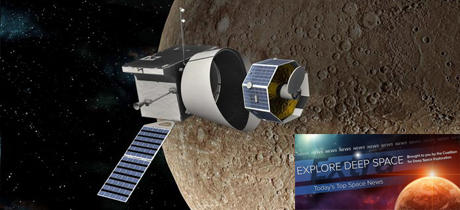
In Today’s Deep Space Extra… Russian investigators are days from completing their report into the October 11 Soyuz rocket launch aboard with NASA’s Nick Hague and cosmonaut Alexey Ovchinin. European/Japanese BepiColombo mission heads for Mercury. Concern for NASA emerges over proposed 2020 U.S. budget cut.
Human Space Exploration
Report on Soyuz-FG malfunction to be approved on October 30
TASS of Russia (10/20): Roscosmos, the Russian space agency, has set October 30 for completion of a report into the October 11 Soyuz-FG rocket launch abort, which ended with a safe landing for NASA astronaut Hick Hague and cosmonaut Alexey Ovchinin in remote Kazakhstan. The spacecraft with the two fliers was headed for the International Space Station (ISS). The report and recommendations for recovery will be submitted to the state commission responsible for the inquiry. Previous reports have suggested the abort is linked to a signal issue involved in the separation of the rocket’s first and second stages.
Russian launch failure proves why we need NASA’s Space Launch System (SLS) – Op-Ed
The Hill (10/21): On October 11, Russia’s venerable Soyuz rocket experienced a launch abort with NASA astronaut Nick Hague and cosmonaut Alexey Ovchinin aboard. They landed safely, but the incident raises concerns over a need for more than one means of launching humans, writes space historian Johnathan Ward. Ward concludes NASA’s Space Launch System (SLS) should be among the options for reaching deep space with human explorers. Currently suspended, Russia’s Soyuz offers the only means of transporting crews to the six person International Space Station (ISS).
Want to be a Mars astronaut? You’ll need the proper mindset
Discover (11/1): With Mars as well as the moon on the horizon for human exploration, researchers are studying the psychological challenges. A round trip Mars mission is likely to span three years. Both the moon and Mars will separate explorers from Earth at great distances. Analog missions across the globe are playing a role as planners acknowledge that selecting voyagers with compatible psychological profiles is critical to mission success.
Space Science
Ariane 5 launches two satellites on 7-year voyage to Mercury
Spaceflightnow.com (10/20): BepiColombo, a joint European/Japanese $1.9 billion planetary science mission to Mercury launched late Friday atop anAriane 5 rocket from French Guiana. The complex seven year journey seeks to place two satellites into orbit around Mercury. The spacecraft are to characterize the planet’s composition, density and magnetic field and whether shadowed craters may harbor water ice.
Chandra X-ray observatory should return to action next week
Space.com (10/20): NASA’s Chandra X-ray Observatory slipped into “safe mode” on October 10 in response to a gyroscope problem. On Friday, the space agency said Chandra could return to action this week, with the troublesome gyro placed in a reserve mode. Chandra, one of NASA’s four Great Observatories, was launched in July 1999.
How the Hubble unlocked the universe
Universe Today (10/20): On the ground, NASA is leading efforts to overcome a problem with the gyroscopes that point and steady the Hubble Space Telescope, which has been orbiting the Earth and providing ground breaking science for almost three decades.
Other News
Congress won’t tolerate big NASA cuts, lawmaker predicts
Politico (10/19): Last week, President Trump called for federal agencies to cut their budgets by 5 percent, or more, an approximately $1 billion reduction for NASA. Such a cut could be a major obstacle for NASA as it refocuses its human space exploration efforts from low Earth orbit to deep space and first with the assembly of a human tended lunar Gateway, notes Todd Harrison, director of the Aerospace Security Project at the Center for Strategic and International Studies.
White House temporarily lifts sanctions on Russia’s space chief for U.S. visit
Moscow Times of Russia (10/19): The White House has temporarily lifted a sanction that blocked the entry of Dmitry Rogozin, the head of Russian’s space agency, to the U.S. No date, however, has been set for a visit that NASA Administrator Jim Bridenstine says will help to secure relations between the space programs of the two countries.
Officials cut ribbon to celebrate opening of southern road to spaceport
Las Cruces Sun News of New Mexico (10/19): After several years of uncertainty over its future, a new roadway leading to Spaceport America and linked to Interstate 35 opened in July. Local officials and executives from Virgin Galactic, a major spaceport tenant, gathered Friday for a traditional ribbon cutting ceremony to celebrate.
Major Space Related Activities for the Week
Major space related activities for the week of October 21-27, 2018
Spacepolicyonline.com (10/21): Expect lots of space policy discussion. The American Astronautical Society’s Von Braun Symposium gathers in Huntsville, Alabama, on Wednesday and Thursday with a theme, Galvanizing U.S. Leadership in Space. The American Astronomical Society’s Division of Planetary Sciences meets in Knoxville, Tennessee, with sessions on Japan’s Hyabusa 2 recent asteroid encounter mission and NASA’s upcoming New Horizons flyby of the distant Kuiper Belt Object, Ultima Thule. The National Space Council is to meet for its fourth time on Tuesday to discuss plans for a Space Force.