
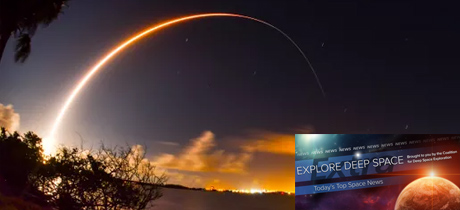
In Today’s Deep Space Extra… NASA astronaut Nick Hague offers an inside look at last Thursday’s dramatic Soyuz launch abort, while Russian investigators continue to assess the cause. December skies may host a naked eye comet. A United Launch Alliance (ULA) Atlas 5 launch early Wednesday placed an Air Force communications satellite in orbit.
Human Space Exploration
NASA astronaut unfazed by frightening Soyuz launch abort
CBS News (10/16): During a series of brief interviews with U.S. news media on Tuesday, NASA astronaut Nick Hague declared he’s taken last Thursday’s Russian Soyuz launch abort in professional stride and feels prepared to serve aboard the International Space Station (ISS) when his managers are ready. Hague, in the company of cosmonaut Alexey Ovchinin, descended safely to Earth in their Space Station bound Soyuz MS-10. Hague, launching for the first time, expressed confidence in Russia’s space agency to determine the cause and implement a response that would permit him to launch again.
Signal failure may be to blame for Soyuz stage’s separation problem, says Roscosmos
TASS of Russia (10/16): A Russian commission looking into the root cause of the October 11 Soyuz MS-10 launch abort with NASA astronaut Nick Hague and cosmonaut Alexey Ovchinin board has found indications of a signal failure behind a collision of the first and second stages at separation. The rocket’s descent module descended safely with the two men, who were in route to the International Space Station (ISS).
Russian cosmonauts to examine Soyuz MS-09 in mid-December spacewalk before its return to Earth
Interfax of Russia (10/17): In late August, ground control teams detected a small leak aboard the International Space Station (ISS). The Station’s crew traced the source to Russia’s Soyuz MS-08 capsule which was docked to the Station’s Russian segment. It was repaired by the Station’s cosmonauts, but the cause remains under investigation. Last week’s Soyuz launch abort has delayed plans for a Russian spacewalk to look for signs of external damage from November until mid-December.
NASA wants to send humans to Venus here’s why that’s a brilliant idea
The Conversation (10/16): NASA is assessing a mission to Venus in which astronauts would explore from an airship, and possibly establish and airborne outpost in the clouds.
Space Science
Coming soon, the comet of the year
Spaceweather.com (10/17): Comet 46P/Wirtanen should be visible to the naked eye for much of December as it passes close to the Earth, with the closest approaching coming on December 16.
Here’s what the first images from the Event Horizon might look like
Universe Today (10/16): Coming soon, perhaps, an opportunity to view the Event Horizon around Sagittarius A, the super massive black hole at the center of the Milky Way galaxy. The prospective view would be coming from the Event Horizon telescope, which is actually a team effort provided by radio telescopes spread across the globe. A collection of 400 astronomers are studying the data gathered over a four year period that drew to a close in 2017.
Other News
Powerful Atlas V rocket blasts off from Cape Canaveral with $1.8 billion Air Force satellite
Coalition Member in the News – United Launch Alliance
Florida Today (10/17): A secure U.S. Air Force communications satellite successfully launched atop a United Launch Alliance Atlas (ULA) 5 rocket from Cape Canaveral Air Force Station, Florida, early Wednesday.
Asteroid mining: Appealing to our romantic side?
The Space Review (10/16): Don’t count on asteroid mining for personal wealth, writes John Hollaway, a retired mining consultant, in an op-ed. Hollaway draws his conclusion from his terrestrial experiences with gold as a commodity. Far more assessment of asteroid geology is necessary before assessing their value, Hollaway writes.
China says it will put parachutes on its rocket boosters next year and here’s why
GB Times of Finland (10/16): China’s Long March 3B will sport boosters with parachutes in 2019 to lessen the threat of debris from rockets launched from the Xichang Satellite Launch Centre from falling into populated areas.
Long March 3B adds another spacecraft duo for China’s BeiDou satellite navigation system
Space.com (10/16): A Chinese Long March 3b rocket added two more spacecraft to China’s growing Beidou global navigation satellite constellation with a launch on Monday.