
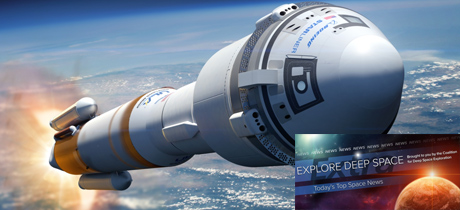
In Today’s Deep Space Extra… NASA Administrator Jim Bridenstine expresses confidence the U.S. will be launching astronauts once again by mid-2019. NASA Associate Administrator for Human Exploration and Operations Bill Gerstenmaier backs Vice President Mike Pence’s prediction that NASA astronauts will occupy the human tended lunar Gateway by the end of 2024. Orion elements are coming together at NASA’s Kennedy Space Center to support the first uncrewed test flight of the Space Launch System (SLS) and Orion capsule by mid-2020.
Human Space Flight
NASA chief: ‘Without question,’ U.S. rockets will launch astronauts from U.S. soil next year
Coalition Member in the News – Boeing
USA Today (8/27): In a Washington interview with USA Today, NASA Administrator Jim Bridenstine on Monday offered assurances that NASA will be launching astronauts from U.S. soil again by mid-2019. His pronouncement offers confidence that NASA’s Commercial Crew Program and its partners, Boeing and SpaceX, will complete uncrewed and crewed test flights leading to certifications of Boeing’s CST-100 Starliner and SpaceX’s Dragon 2 to begin the regular transportation of astronauts to and from the International Space Station (ISS). U.S. launches came to an end with the retirement of NASA’s shuttle fleet in mid-2011. The U.S. now pays Russia $82 million a seat to launch astronauts to the Space Station on Soyuz rockets. “Without question, by the middle of next year, we’ll be flying American astronauts on American rockets from American soil,” Bridenstine told USA TODAY in an exclusive interview. “We’re so close.”
Gerstenmaier confident about meeting Pence’s 2024 goal
Spacepolicyonline.com (8/28): The NASA Advisory Council is in session this week at the Ames Research Center. Monday, Bill Gerstenmaier, NASA’s Associate Administrator for Human Exploration and Operations, expressed confidence the agency can meet a 2024 date for launching the first astronauts to the human tended lunar Gateway, whose assembly is to begin in 2022. Vice President Mike Pence mentioned the 2024 date for first Gateway occupancy during remarks at NASA’s Johnson Space Center (JSC) last Thursday. Bill Hill, who leads NASA’s exploration mission development, told the advisory session that the first crewed flight of the Space Launch System (SLS) and Orion capsule is envisioned for mid-2022, about two years after Exploration Mission-1 (EM-1), the first uncrewed test flight of the SLS and Orion.
Orion elements coming together for EM-1
Coalition Member in the News – Lockheed Martin
NASAspaceflight.com (8/26): At NASA’s Kennedy Space Center (KSC), the Orion related elements for Exploration Mission-1 (EM-1), the first joint test flight of Orion and the Space Launch System (SLS), are starting to come together, with a launch of the multi-week uncrewed test flight planned by 2020. The European Service Module, which has yet to reach KSC, could be the pace setter, however. The flight will take Orion, absent its abort and environmental control systems, around the Moon and back to Earth for an ocean splashdown and recovery.
Space Science
Why Jupiter’s rapid growth spurt was delayed for millions of years
Space.com (8/27): A Swiss led research team has uncovered some new clues as to why Jupiter is so large and may have waited about two million years to undergo a growth spurt. It all has to do with the accretion pattern of dust and gas to form early planetary bodies and then the accretion of the larger bodies. An explanation of the modeling appears in the journal Nature Astronomy.
We’re in the Milky Way’s second life, star formation was shut down for billions of years.
Universe Today (8/26): The Milky Way galaxy may have formed early in the 13.8 billion year scale of the existence of the universe. But a new study by Japanese researchers suggests there may have been two growth periods interrupted by billions of years of relative inactivity. The theory is based on a notion called cold flow accretion.
Other News
Why airworthiness certification is necessary for commercial human spaceflight
The Space Review (8/27): The U.S. is making major strides in commercial as well as civil government, national security and military space flight. However, if it is to achieve an aircraft like commercial access to space for humans, the nation must embrace safety and reliability standards spelled out in a federal airworthiness certificate, writes Mike Snead, an engineer and associate fellow of the AIAA and president of the Spacefaring Institute.
OneWeb, Arianespace target December-February for first Soyuz launch
SpaceNews.com (8/27): Ariancespace and OneWebb are working to preserve an end of the year Soyuz launch opportunity for the first low Earth orbit broadband satellite constellation. Eventually, OneWebb looks to orbit 900, perhaps 2,000 of the small communications satellites for its network.