
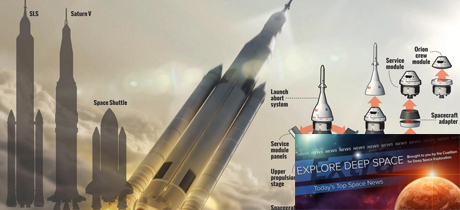
In Today’s Deep Space Extra… NASA official outlines plan to accelerate first launch of the Space Launch System (SLS) and Orion with astronauts on board.
Human Space Exploration
Exploration Mission-2 gets a re-do
Spacepolicyonline.com (4/25): NASA is revising plans for Exploration Mission-2 (EM-2), the first combined launch of the Space Launch System (SLS) and Orion capsule with astronauts aboard. Under a revision outlined by Bill Gerstenmaier, NASA Associate Administrator for Human Exploration and Operations, before a Space Transportation Association audience in Washington on Wednesday, EM-2 would launch with the Interim Cryogenic Propulsion Stage instead of a more capable Exploration Upper Stage in order to accelerate the crewed mission test flight.
Sen. Schumer wants Challenger astronaut memorial in New York
New York Times (4/25): U.S. Sen. Charles Schumer, of New York, the Senate minority leader, is seeking a New York memorial for Greg Jarvis, a native of the state and one of seven astronauts that perished aboard the shuttle Challenger on Jan. 28, 1986. Jarvis launched as a payload specialist and engineer employed by Hughes Aircraft.
Space Science
Sky and Telescope (4/24): This week marked the 28th anniversary of the launch of the Hubble Space Telescope aboard the shuttle Discovery. To mark the occasion, NASA presented a colorful image of the Lagoon Nebula. The landmark space observatory was serviced and upgraded five times by space shuttle crews, most recently in 2009, and counts 1.5 million observations.
Team aims to use new NASA telescope to capture light from the first stars to be born in the universe
Physics.org (4/25): An assessment by scientists from Arizona State University concludes the James Webb Space Telescope (JWST) is equipped to detect the universe’s very first stars, thanks to its infrared optics. At long wavelengths responsive to the expansion of the universe, the radiance could reveal much about early chemistry and how the early mix of elements contributed to future generations of stars and the planets that orbit them
Just two more days to send your name to the Sun!
The Parker Solar Probe will revolutionize our understanding of the Sun, swooping to within 4 million miles of our celestial light-giver. You can send your name along on the mission, but time is running out. Find the hottest ticket here! Deadline to sign up and receive your certificate is 11:59 p.m. on April 27.
Asteroid Miners’ Arkyd-6 satellite aces big test in space
Space.com (4/25): Launched just three months ago aboard an Indian launch vehicle, the Arkyd-6 small satellite developed by Planetary Resources, of Redmond, Wash., has achieved post launch check out. The spacecraft is part of future plans by the company to survey asteroids for resources, among them water.
How many planets is TESS going to find?
Universe Today (4/25): NASA’s Transiting Exoplanet Survey Satellite mission was launched April 18 on a two year primary mission to seek evidence of planets around bright stars in the Milky Way near the Earth. A recent study suggests that TESS may succeed in discovering between 4,400 and 4,700 new planets. The James Webb Space Telescope (JWST), the designated successor to the Hubble Space Telescope, is to follow up by characterizing the discoveries and looking for signs of biological activity in the atmospheres of the planets.
Biggest ever 3D map of the galaxy pinpoints 1.7 billion stars
New Scientist (4/25): New data from the European Space Agency’s (ESA) Earth orbiting Gaia satellite identified 1.7 billion stars within 8,000 light years of the Earth.
Other News
Congressional auditors raise red flags on EELV costs, national security launch industrial base
Space News (4/25): A report Wednesday from the U.S. Government Accountability Office raises concerns over the U.S. Air Force Evolved Expendable Launch Vehicle program and rising costs associated with the launches of national security satellite missions. New vehicles or variants that introduce changes to the original design “can pose increased cost and schedule risks until they are proven through multiple successful flights,” according to the report.
European environmental observer launched by Russian rocket
Spaceflightnow.com (4/25): The European Sentinel 3B environmental satellite was launched Wednesday from Russia’s Plesetsk Cosmodrome. The new spacecraft was developed to monitor the Earth’s oceans, eroding ice sheets and the status of vegetation.