

Last Thursday, the most prestigious award in aerospace was given to a very exciting mission.
This award, known as the Collier Trophy, is given annually for the country’s greatest achievement in aeronautics or astronautics of the preceding year. This year’s winner was the mission whose spacecraft was the first to orbit two extraterrestrial bodies – NASA’s Dawn mission.
Launched in September 2007, Dawn is managed by NASA’s Jet Propulsion Laboratory (JPL). The spacecraft has been exploring the two largest objects in the asteroid belt between Mars and Jupiter. In July 2011, it visited the protoplanet Vesta. The mission studied Vesta for more than a year before moving onto the largest object in the asteroid belt, the dwarf planet Ceres. Together, Vesta and Ceres account for about 40% of the asteroid belt’s mass.
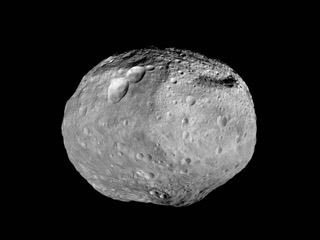
Vesta
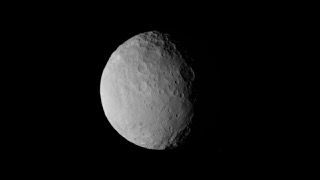
Ceres
Dawn was expected to remain locked in orbit around Ceres after its mission ends, but in April of 2016 NASA announced that they are considering a third mission. The proposed destination has not yet been revealed.

An artist’s concept of the Dawn spacecraft above Ceres.
The Dawn mission is propelled using an ion engine – a method of propulsion only demonstrated in one mission prior to this known as Deep Space 1. Ion propulsion is efficient, lightweight, and very useful over long periods of time. Although this form of propulsion makes a small amount of thrust, it can create extremely high velocities when used continuously over time. For example, Dawn’s speed relative to Earth on May 12 was 93,130 mph.

This image shows a hot fire test for Deep Space 1.
While demonstrating futuristic in-space propulsion, Dawn is also expanding what we know about the history of the solar system. The information collected from Dawn’s instruments will be studied by scientists over time, and will allow us to learn about the formation of the solar system as well as the evolutionary paths of two very different celestial bodies. Vesta is dry and appears similar to inner solar system rocky bodies, while the surface of Ceres contains water-bearing minerals and appears to have more in common with icy moons that are in the outer solar system.
Dawn’s instruments study the mass, shape, volume, and spin state of both targets. They investigate the internal structure and core size as well as the tectonic and thermal history of each target. The spacecraft takes photos of the surface, creates a topographic map and maps the elemental and mineralogical composition. Each target is studied from a high altitude orbit and low altitude orbit.

Ceres low-altitude mapping
The motivation for this mission is to understand the conditions under which Ceres and Vesta formed, the nature of their building blocks, and the difference in their formation and evolution. As Ceres and Vesta did not evolve into larger bodies, they provide an untainted view of the early formation of planets. Scientists will continue to analyze the information collected by Dawn for many years to come.
As the first spacecraft to orbit two extraterrestrial destinations, successfully demonstrate the benefits of ion propulsion and provide data to enhance our knowledge about the formation of planets, Dawn will continue to be celebrated in the future for the path it paves in space exploration.
The outstanding success of NASA’s Dawn mission is possible because of its method of propulsion. By successfully demonstrating the use of ion propulsion, we are at the dawn of a new era in deep space exploration. In the future, missions will use this capable technology to continue expanding our reach into the universe.
Coalition founding member Orbital ATK is NASA’s industry partner on Dawn. Thank you for your outstanding work, and congratulations to Orbital ATK, NASA and JPL, on the award of the 2016 Collier Trophy.